
Project 264: A. L. Wetterer, M. V. Rockman, N. B. Simmons. 2000. Phylogeny of phyllostomid bats (Mammalia: Chiroptera): data from diverse morphological systems, sex chromosomes, and restriction sites. Bulletin of the American Museum of Natural History. 248:1-200.
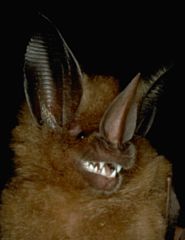
Abstract
Phyllostomidae is a large (> 140 species), diverse clade of Neotropical bats. Different species in this family feed on blood, insects, vertebrates, nectar, pollen, and fruits. We investigated phylogenetic relationships among all genera of phyllostomid bats and tested monophyly of several genera (e.g., Micronycteris, Mimon, Artibeus, Vampyressa) using 150 morphological, karyological, and molecular characters. Results of parsimony analyses of these combined data indicate that all traditionally recognized phyllostomid subfamilies are monophyletic and that most taxa that share feeding specializations form clades. These results largely agree with studies that have used a taxonomic congruence approach to evaluate karyological, immunological, and limited sets of morphological characters, although our finding that Phyllostominae is monophyletic is novel. Our results indicate that several genera (Micronycteris, Artibeus, Vampyressa) are not monophyletic. We propose a new classification for Phyllostomidae that better reflects hypothesized evolutionary relationships. Important features of this new classification include: (1) formal recognition of two clades that group nectarivorous and frugivorous subfamilies, respectively, (2) redefinition of Glossophaginae and recognition of two tribal-level taxa within that subfamily, (3) recognition of several tribal-level taxa in Phyllostominae, (4) formal recognition of two clades that have been colloquially referred to as 'short-faced' and 'long-faced' stenodermatines, (5) elevation of the subgenera of Micronycteris to generic rank, (6) recognition of Mesophylla as a junior synonym of Ectophylla, (7) recognition of Enchisthenes as a distinct genus, and (8) retention of Dermanura and Koopmania as subgenera of Artibeus. Although Vampyressa is not monophyletic in our tree, we recommend no nomenclatural change because we did not include all Vampyressa species in our study. Comparisons of character and taxonomic congruence approaches indicate that character congruence provides improved resolution of relationships among phyllostomids. Many data sets are informative only at limited hierarchical levels or in certain portions of the phyllostomid tree. Although both chromosomal and immunological data provide additional support for several clades that we identified, these data sets are incongruent with many aspects of our phylogenetic results. These conflicts may be due to methodological constraints associated with the use of karyological and immunological data (e.g., problems with assessing homologies and distinguishing primitive from derived traits). Among other observations, we find that Macrotus waterhousii, which has been thought to have the primitive karyotype for the family, nests well within the phyllostomine clade. This suggests that results of previous analyses of chromosomal data may need to be reevaluated. Mapping characters and behaviors on our phylogenetic tree provides a context for evaluating hypotheses of evolution in Phyllostomidae. Although previous studies of uterine evolution in phyllostomids and other mammals have generally supported the unidirectional progressive fusion hypothesis, our results indicate that intermediate stages of external uterine fusion are often derived relative to the fully simplex condition, and that reversals also occur with respect to internal uterine fusion. Uterine fusion therefore appears to be neither completely unidirectional nor progressive in Phyllostomidae. Evolution of the vibrissae and noseleaf is similarly complex and homoplasy is common in these structures; however, many transformations in these systems diagnose clades of phyllostomids. Within Phyllostomidae, there is considerable derived reduction in numbers of vibrissae present in various vibrissal clusters. The phyllostomid noseleaf seems to have become a much more elaborate and complex structure over evolutionary time. Primitively within the family, the spear was short, the internarial region was flat, and the horseshoe was undifferentiated from the upper lip. Subsequently, within the various subfamilies, the spear became more elongate, the central rib and other internarial structures evolved, and the labial horseshoe became flaplike or cupped in some taxa. Dietary evolution in phyllostomids appears somewhat more complex than previously thought. We find that most of the major dietary guilds (e.g., frugivory, sanguivory) are represented by a single large clade within Phyllostomidae, indicating that each feeding specialization evolved once. However, reversals do occur (e.g., loss of nectar- and pollen-feeding in many phyllostomines and stenodermatines), and some specializations may have evolved more than once (e.g., carnivory)Read the article »
Project DOI: 10.7934/P264, http://dx.doi.org/10.7934/P264
| This project contains | Matrices |
|---|---|
Download Project SDD File  | Total scored cells: 7576 Total media associated with cells: 0 Total labels associated with cell media: 0 |
| Characters | |
| Total characters: 150 Total characters with associated media: 0 Total characters with media with labels: 0 Total character states: 375 Total character states with associated media: 0 Total character states with media with labels:0 Total unordered/ordered characters:150/0 |
Currently Viewing:
MorphoBank Project 264
MorphoBank Project 264
- Creation Date:
27 March 2009 - Publication Date:
27 March 2009 - Project views: 34799
- Media downloads: 4
- Matrix downloads: 30
Authors' Institutions
- Columbia University
- American Museum of Natural History
Members
| member name | taxa |
specimens |
media | media notes | chars | character
| cell scorings (scored, NPA, "-") | cell
| rules | ||||||||||
| Nancy Simmons Project Administrator | 69 | 1 | 1 | 0 | 150 | 0 | 0 | 0 | 7576 (6745, 0, 831) | 0 | 0 | 0 | 0 | ||||||
Taxonomic Overview for Matrix 'M675' (63 Taxa)
| taxon | unscored cells |
scored cells |
no cell support |
NPA cells |
"-" cells | cell images | labels on cell images |
member access |
| [1] Mormoops Last Modified in 12/05/13 | 18 | 107 | 106 | 0 | 26 | 0 | 0 | 1 |
| [2] Pteronotus Last Modified in 12/05/13 | 17 | 112 | 107 | 0 | 26 | 0 | 0 | 1 |
| [3] Noctilio Last Modified in 12/05/13 | 8 | 115 | 114 | 0 | 28 | 0 | 0 | 1 |
| [4] Desmodus Last Modified in 12/05/13 | 5 | 121 | 121 | 0 | 24 | 0 | 0 | 1 |
| [5] Diaemus Last Modified in 12/05/13 | 50 | 79 | 79 | 0 | 21 | 0 | 0 | 1 |
| [6] Diphylla Last Modified in 12/05/13 | 32 | 98 | 98 | 0 | 20 | 0 | 0 | 1 |
| [7] Brachyphylla Last Modified in 12/05/13 | 10 | 125 | 125 | 0 | 15 | 0 | 0 | 1 |
| [8] Erophylla Last Modified in 12/05/13 | 29 | 108 | 108 | 0 | 13 | 0 | 0 | 1 |
| [9] Phyllonycteris Last Modified in 12/05/13 | 17 | 121 | 120 | 0 | 13 | 0 | 0 | 1 |
| [10] Anoura Last Modified in 12/05/13 | 11 | 131 | 128 | 0 | 11 | 0 | 0 | 1 |
| [11] Choeroniscus Last Modified in 12/05/13 | 20 | 119 | 116 | 0 | 14 | 0 | 0 | 1 |
| [12] Choeronycteris Last Modified in 12/05/13 | 17 | 119 | 119 | 0 | 14 | 0 | 0 | 1 |
| [13] Glossophaga Last Modified in 12/05/13 | 1 | 140 | 140 | 0 | 9 | 0 | 0 | 1 |
| [14] Hylonycteris Last Modified in 12/05/13 | 30 | 108 | 108 | 0 | 12 | 0 | 0 | 1 |
| [15] Leptonycteris Last Modified in 12/05/13 | 8 | 132 | 132 | 0 | 10 | 0 | 0 | 1 |
| [16] Lichonycteris Last Modified in 12/05/13 | 33 | 104 | 104 | 0 | 13 | 0 | 0 | 1 |
| [17] Monophyllus Last Modified in 12/05/13 | 17 | 124 | 124 | 0 | 9 | 0 | 0 | 1 |
| [18] Musonycteris Last Modified in 12/05/13 | 70 | 69 | 69 | 0 | 11 | 0 | 0 | 1 |
| [19] Scleronycteris Last Modified in 12/05/13 | 87 | 52 | 52 | 0 | 11 | 0 | 0 | 1 |
| [20] Lionycteris Last Modified in 12/05/13 | 22 | 120 | 120 | 0 | 8 | 0 | 0 | 1 |
| [21] Lonchophylla Last Modified in 12/05/13 | 15 | 127 | 126 | 0 | 9 | 0 | 0 | 1 |
| [22] Platalina Last Modified in 12/05/13 | 36 | 103 | 103 | 0 | 11 | 0 | 0 | 1 |
| [23] Chrotopterus Last Modified in 12/05/13 | 36 | 105 | 105 | 0 | 9 | 0 | 0 | 1 |
| [24] Micronycteris sylvestris Last Modified in 12/05/13 | 57 | 82 | 82 | 0 | 11 | 0 | 0 | 1 |
| [25] Lonchorhina Last Modified in 12/05/13 | 35 | 107 | 104 | 0 | 11 | 0 | 0 | 1 |
| [26] Macrophyllum Last Modified in 12/05/13 | 35 | 103 | 103 | 0 | 12 | 0 | 0 | 1 |
| [27] Macrotus Last Modified in 12/05/13 | 4 | 137 | 137 | 0 | 9 | 0 | 0 | 1 |
| [28] Micronycteris brachyotis Last Modified in 12/05/13 | 56 | 84 | 84 | 0 | 10 | 0 | 0 | 1 |
| [29] Micronycteris hirsuta Last Modified in 12/05/13 | 43 | 99 | 99 | 0 | 8 | 0 | 0 | 1 |
| [30] Micronycteris megalotis Last Modified in 12/05/13 | 41 | 100 | 100 | 0 | 9 | 0 | 0 | 1 |
| [31] Micronycteris minuta Last Modified in 12/05/13 | 42 | 99 | 99 | 0 | 9 | 0 | 0 | 1 |
| [32] Mimon bennettii Last Modified in 12/05/13 | 50 | 90 | 90 | 0 | 10 | 0 | 0 | 1 |
| [33] Mimon crenulatum Last Modified in 12/05/13 | 36 | 103 | 103 | 0 | 11 | 0 | 0 | 1 |
| [34] Phylloderma Last Modified in 12/05/13 | 46 | 92 | 92 | 0 | 12 | 0 | 0 | 1 |
| [35] Phyllostomus Last Modified in 12/05/13 | 3 | 138 | 135 | 0 | 12 | 0 | 0 | 1 |
| [36] Tonatia Last Modified in 12/05/13 | 32 | 111 | 106 | 0 | 12 | 0 | 0 | 1 |
| [37] Trachops Last Modified in 12/05/13 | 29 | 110 | 110 | 0 | 11 | 0 | 0 | 1 |
| [38] Micronycteris nicefori Last Modified in 12/05/13 | 33 | 105 | 105 | 0 | 12 | 0 | 0 | 1 |
| [39] Vampyrum Last Modified in 12/05/13 | 38 | 99 | 99 | 0 | 13 | 0 | 0 | 1 |
| [40] Carollia Last Modified in 12/05/13 | 1 | 137 | 135 | 0 | 14 | 0 | 0 | 1 |
| [41] Rhinophylla Last Modified in 12/05/13 | 37 | 100 | 98 | 0 | 15 | 0 | 0 | 1 |
| [42] Artibeus Last Modified in 12/05/13 | 3 | 137 | 133 | 0 | 14 | 0 | 0 | 1 |
| [43] Chiroderma Last Modified in 12/05/13 | 33 | 111 | 104 | 0 | 13 | 0 | 0 | 1 |
| [44] Dermanura Last Modified in 12/05/13 | 36 | 110 | 101 | 0 | 13 | 0 | 0 | 1 |
| [45] Ectophylla alba Last Modified in 12/05/13 | 48 | 86 | 86 | 0 | 16 | 0 | 0 | 1 |
| [46] Mesophylla macconellii Last Modified in 12/05/13 | 37 | 100 | 100 | 0 | 13 | 0 | 0 | 1 |
| [47] Enchisthenes Last Modified in 12/05/13 | 33 | 103 | 103 | 0 | 14 | 0 | 0 | 1 |
| [48] Koopmania Last Modified in 12/05/13 | 54 | 83 | 83 | 0 | 13 | 0 | 0 | 1 |
| [49] Platyrrhinus Last Modified in 12/05/13 | 15 | 127 | 121 | 0 | 14 | 0 | 0 | 1 |
| [50] Uroderma Last Modified in 12/05/13 | 13 | 123 | 123 | 0 | 14 | 0 | 0 | 1 |
| [51] Vampyressa bidens Last Modified in 12/05/13 | 53 | 84 | 84 | 0 | 13 | 0 | 0 | 1 |
| [52] Vampyressa nymphaea Last Modified in 12/05/13 | 41 | 96 | 96 | 0 | 13 | 0 | 0 | 1 |
| [53] Vampyressa pusilla Last Modified in 12/05/13 | 28 | 108 | 108 | 0 | 14 | 0 | 0 | 1 |
| [54] Vampyrodes Last Modified in 12/05/13 | 32 | 105 | 105 | 0 | 13 | 0 | 0 | 1 |
| [55] Ametrida Last Modified in 12/05/13 | 35 | 102 | 102 | 0 | 13 | 0 | 0 | 1 |
| [56] Ardops Last Modified in 12/05/13 | 38 | 102 | 102 | 0 | 10 | 0 | 0 | 1 |
| [57] Ariteus Last Modified in 12/05/13 | 35 | 105 | 105 | 0 | 10 | 0 | 0 | 1 |
| [58] Centurio Last Modified in 12/05/13 | 28 | 100 | 100 | 0 | 22 | 0 | 0 | 1 |
| [59] Phyllops Last Modified in 12/05/13 | 35 | 104 | 104 | 0 | 11 | 0 | 0 | 1 |
| [60] Pygoderma Last Modified in 12/05/13 | 39 | 100 | 100 | 0 | 11 | 0 | 0 | 1 |
| [61] Stenoderma Last Modified in 12/05/13 | 38 | 102 | 102 | 0 | 10 | 0 | 0 | 1 |
| [62] Sphaeronycteris Last Modified in 12/05/13 | 51 | 85 | 85 | 0 | 14 | 0 | 0 | 1 |
| [63] Sturnira Last Modified in 12/05/13 | 7 | 137 | 128 | 0 | 15 | 0 | 0 | 1 |
Project views
| type | number of views | Individual items viewed (where applicable) |
| Total project views | 34799 | |
| Project overview | 3820 | |
| Matrix views | 2549 | Matrix landing page (2165 views); Phyllostomid matrix (384 views); |
| Media views | 6179 | Media search (5146 views); M26783 (1033 views); |
| Specimen list | 3032 | |
| Taxon list | 19215 | |
| Documents list | 4 |
Project downloads
| type | number of downloads | Individual items downloaded (where applicable) |
| Total downloads from project | 396 | |
| Matrix downloads | 30 | Phyllostomid matrix (30 downloads); |
| Project downloads | 362 | |
| Media downloads | 4 | M26783 (4 downloads); |